Revolution and Representation in Torre Bela and Linha Vermelha
In both cinema and life, the boundary between authenticity and construction is often blurred. Filmmakers like Thomas Harlan and José Filipe Costa invite us to explore this tension by turning real-life events into staged narratives. Their works challenge us to question whether reality can be “directed” and, if so, what ethical considerations arise from such an approach.
What is the boundary between documentation and performance? Between historical truth and cinematic construction? Is it possible to direct the reality as if it was a film? These were some of the questions I discussed during a roundtable I participated in last semester at New York University, commemorating the 50th anniversary of the Carnation Revolution. The discussion focused on the works of José Filipe Costa and Thomas Harlan, particularly their films Linha Vermelha (Red Line, 2011) and Torre Bela (1975), which explore the intersections of revolutionary ideals, cinema, and memory.

The Director: Between Observer and Instigator
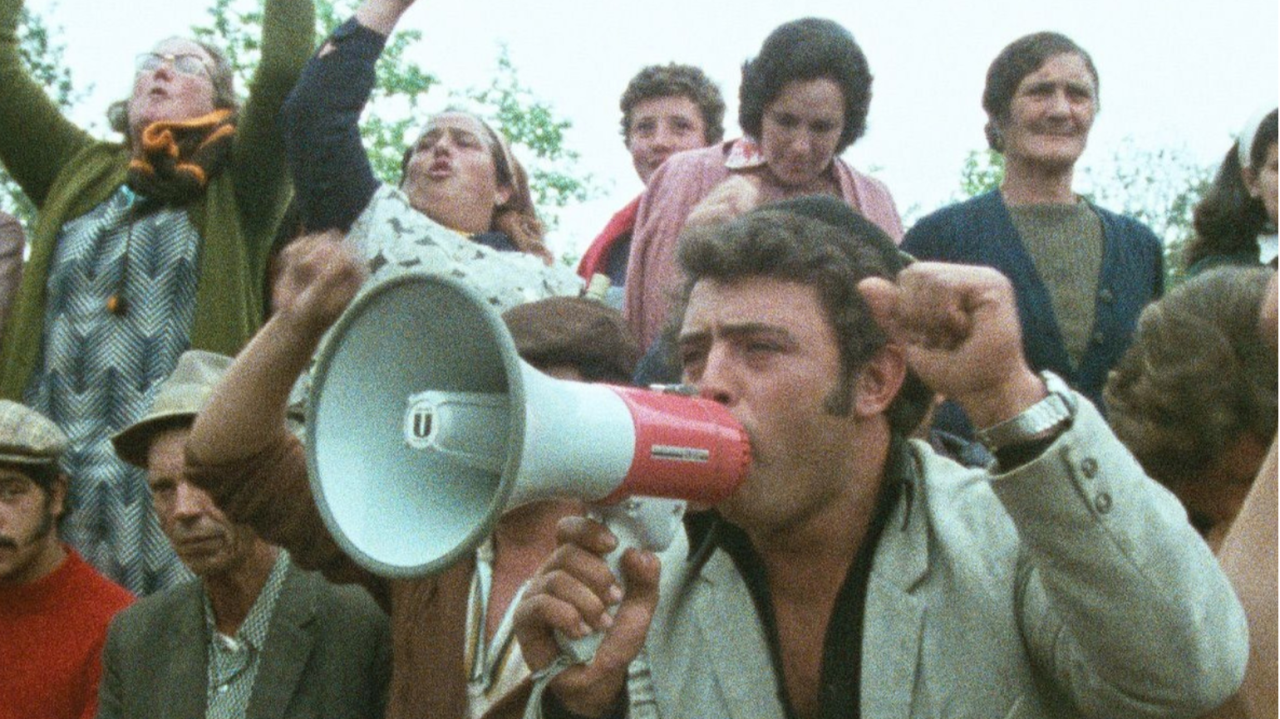
Both films use the medium of cinema as a tool to reflect and shape revolutionary ideals. In Torre Bela, Thomas Harlan documents the occupation of an aristocratic estate in Ribatejo by a group of Portuguese workers and peasants during the year following the 1974 Carnation Revolution. However, Harlan’s approach blurs the lines between observer and instigator. His directorial choices, including staging and dramatizing moments, raise a still relevant question: Is it ethical to manipulate historical events for the sake of conveying a “greater truth”?
Costa’s Linha Vermelha, on the other hand, takes a meta-cinematic approach. The film interrogates Torre Bela itself, highlighting its artifice and exploring the ethics of documentary filmmaking. Costa employs self-reflexivity as “an ethical need to render visible” the constructed nature of Harlan’s work, inviting viewers to reconsider the relationship between truth, performance, and revolutionary politics.
The Working Class and Democratic Tensions
The Carnation Revolution highlighted a deep tension between two democratic ideals: representative democracy, rooted in bourgeois values, and direct democracy, championed by workers and peasants. Both Torre Bela and Linha Vermelha examine these dynamics through the struggles of the working class.
In Torre Bela, the estate occupation becomes a powerful symbol of reversing power structures and dismantling class distinctions. The workers’ attempt to claim control over their means of production embodies broader socialist ideals. However, the film also underscores the fragility of these movements, particularly as leadership figures—like Wilson, a key character—rise and fall in the chaotic revolutionary context.
Linha Vermelha continues this dialogue, reflecting on how history is told and retold, often prioritizing certain narratives over others. By highlighting the dichotomy between representative and direct democracy, Costa’s film prompts viewers to question how these tensions resonate in contemporary Portuguese society.

Translation and Interpretation
Language barriers and cultural nuances add another layer of complexity to these films. In Torre Bela, the cameraman’s inability to understand Portuguese leads him to focus on the tone and dramatism of the workers’ voices rather than their words. This misinterpretation reflects the broader challenges of translating revolutionary fervor across cultures and mediums. To what extent are the revolution’s core tenets lost—or shaped—through these interpretive processes?

Performance vs. Documentation
Both films explore the intersection of historical documentation and performance. In Torre Bela, Harlan’s direction transforms real-life events into a staged narrative, turning participants into actors. Wilson’s statement, “I ended up being the actor of my own life,” encapsulates this duality. Similarly, in Linha Vermelha, Costa examines the performative nature of historical memory, questioning where the line between fact and fiction lies—and whether such a line can even exist.
Film as a Tool for Change
At their core, these films underscore the revolutionary potential of cinema. Whether it is Harlan using Torre Bela as an “instrument for struggle” or Costa dissecting the ethics of representation, both filmmakers demonstrate the power of film to incite action and provoke reflection. By blending facts and fiction, they challenge audiences to confront the constructed nature of history and the role of media in shaping societal consciousness.

The Legacy of Revolutionary Cinema
Films like Linha Vermelha and Torre Bela are more than historical artifacts. They are living documents that continue to spark debate about democracy, representation, and activism. As Edgar Morin once said about cinéma vérité, such works strive for fraternity, bringing people together in a shared reflection on the human condition.
In revisiting Portugal’s revolutionary past, these films remind the viewers of the enduring relevance of the struggles for equality and justice. They challenge us to rethink not only how history is told but also how it can inspire action in the present.
 Francisco Quinteiro Pires
Leave a comment