
After Stefano Mancuso
Vincent van Gogh and José Saramago lived in different centuries, spoke different languages, and worked in different media, yet both found a source of inspiration in the olive tree. For Van Gogh, the tree became a pictorial motif: expressive, symbolic, and emotionally charged. For Saramago, it functioned as a vessel of memory and a metaphor of cultural belonging, rooted in the landscapes of his Ribatejo childhood.
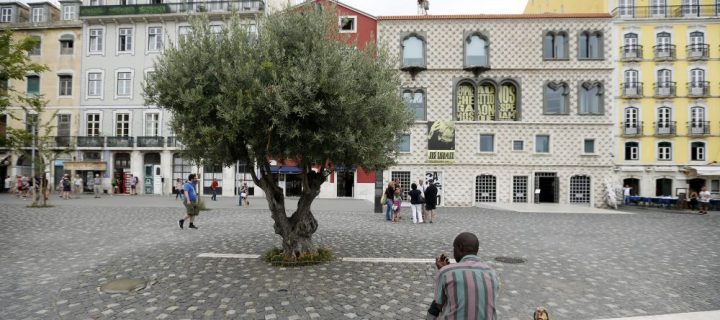
That shared fascination remains palpable in their works in Portugal and the United States. In Lisbon, a centuries-old olive tree transplanted from Saramago’s hometown of Azinhaga stands outside the Casa dos Bicos, headquarters of the José Saramago Foundation. Beneath it rest the writer’s ashes, a book, and soil from Lanzarote, turning the tree into a living reliquary of personal and national identity.
Van Gogh’s bond with olive trees was forged in Provence. During his year at the asylum of Saint-Rémy-de-Provence (1889-90) he painted the groves repeatedly. Van Gogh saw profound symbolism in the twisted branches of olive trees, often using them to convey emotional turmoil and suffering. He juxtaposed the muted gray green of their leaves with intense oranges and reds, creating a fiery, emotionally charged atmosphere. The olive tree became a recurring subject in his work. In a letter to his brother Theo, he wrote that “if you could see the olive trees at this time of year … The silver foliage is greening up against the blue. And the orangish ploughed soil … the murmur of an olive grove has something very intimate, immensely old about it”, as one can see in the exhibition Van Gogh’s Flowers at the New York Botanical Garden (May 24–October 26, 2025).
In As Pequenas Memórias (2006), Saramago describes the flat fields of Azinhaga lined with olive trees scarred by owners’ initials and embedded in rural labor. Saramago also mourns the erasure of those groves by industrial monoculture—a loss he reads as both ecological and cultural, severing communities from a repertoire of collective memories and seasonal rituals.
Their approaches diverge in medium and mood—painterly exuberance versus reflective narration—yet converge in purpose: to charge the olive tree with meanings that exceed the limits of botany. For Van Gogh, the tree becomes a conduit for strong emotions and spiritual searching; for Saramago, it embodies origin, belonging, and resistance to oblivion.
Where Van Gogh’s canvases vibrate with chromatic explosion and inner turbulence, Saramago’s prose whispers of rootedness and the slow pace of history. Both enlist the olive tree as a counterweight to modern flux, a living index of something that outlasts human fragility and projects.
Seen together, their works consider how trees can mediate perspective and memory through art forms and time. The olive tree, gnarled yet regenerative, mirrors Van Gogh’s restless brush and Saramago’s steadfast words—each, in its own way, a rooted answer to the question of how to endure the destructive passage of time.
 Francisco Quinteiro Pires
Leave a comment