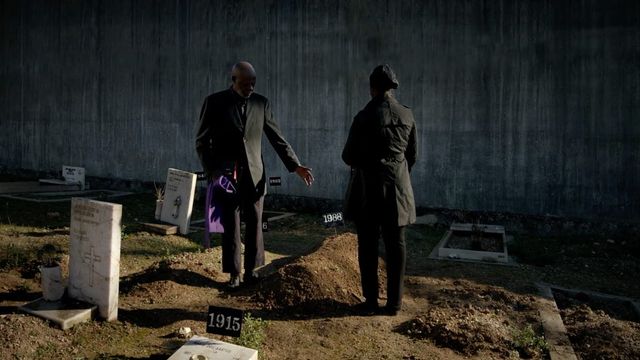
At the launch of Jens Andermann’s Mundus Immundus: Unworlding, Afterlife, and the Cinemas in the Department of Spanish and Portuguese, I offered a reading of Pedro Costa’s Vitalina Varela, focusing on its closing movements. What follows are the notes that shaped my intervention: a meditation drawn from Costa’s film and a resonant passage in Andermann’s text.
This is the passage:
The light that returns, in the final shots of Vitalina Varela featuring the sun-bathed cemetery where Joaquim’s remains have at last been laid to rest, thus also manifests one of the central aims of Costa’s cinema: to find a way out of the hold of the world, even if only for those who participated in the film’s own making. (…) To mourn is also to insist that this life did in fact take place, and therefore a way of making it re-exist by removing it from the limbo where it had been held captive. (…) The “second burial” taking place at the end of Vitalina Varela (…) has no other meaning than this re-affirmation of a compact between earth and community, which exile had left suspended. To tread on the earth, even if it is in the distance of the diaspora, and thus also to reopen a horizon of afterlife for the lives and deaths of the Negrocene, the lives that have not been mourned: such might be today, Costa intimates, the miracle of cinema. (Andermann 65)
Here are my comments:
This quote is from the last paragraph of Chapter 2, “Negrocene.” It describes the end of Vitalina Varela, a film by Pedro Costa released in 2019. Costa’s cinema is the focus of Chapter 2, which approaches colonization, slavery, and diaspora in the Atlantic Ocean. Andermann describes Costa’s work as “a cinema of survivors,” marked by the contrast between light and darkness, which unfolds after “the end of History.”
In these final shots, we see Vitalina Varela, a Cape Verdean migrant who traveled to Portugal to join her husband, Joaquim, more than four decades after he left the African archipelago. When Vitalina arrives in Portugal, her husband is already dead. In fact, his funeral took place three days before her arrival.
What we just saw is the second burial that Jens mentions. In these shots, nobody talks; verbal language is insufficient. As Jens argues elsewhere in the book about ellipsis, silence does not break the meaning in the mundus immundus. It is what holds the meaning together.
In Mundus immundus, the Capitalocene, the title of the first chapter, functions as the extractive matrix from which the other three chapters/concepts derive: transatlantic enslavement, in the Negrocene; neo-fascist enjoyment of destruction, in the Thanatocene; and the response to that extractive matrix, in Afterlife, the mode of remaining and of re-existing/resisting after the end. Afterlife, or sobrevida in Spanish (la vida que sobra, as Jens notes: the life that is left over), is connected to “the miracle of cinema.”
In this context, Jens argues that Vitalina Varela claims a dignified afterlife: the right to be mourned. Reenactment before the camera produces a life that can be grieved. Joaquim’s burial in daylight at the end of the film reaffirms the compact between earth and community, suspended until then by the experience of diaspora. Jens reads this moment, an opening to light and an expansion of space, both extremely rare in Costa’s films, as the “miracle of cinema.”
The concept of the miracle returns in and permeates Chapter 4, “Afterlife,” a chapter about what resists or exists otherwise. Jens explains that afterlife in cinema does not repair the damaged world. Afterlife “punctures” the real, activating its latent insurgent possibilities and calling on the spectator to bear witness and respond.
Jens, if you allow me, we could return to Saint Augustine, who inspires the book’s title. For him, a miracle (miraculum) is an act of God’s will that appears contrary to nature only because humans cannot fully understand nature. As you suggest, miraculum (from mirari; in Spanish, asombrarse, admirarse, contemplar con estupefacción) can be more. It can be the astonishment produced by the sight of the extraordinary, in this case, by the capacity to exist, re-exist, and resist after the end of the world.
Work Cited
Andermann, Jens. Mundus Immundus: Unworlding, Afterlife, and the Cinema. Open Humanities Press, 2026.
Mundus immundus is an open-access book available for free download from Open Humanities Press: www.openhumanitiespress.org/books/download/Andermann_2026_Mundus-immundus.pdf.


Leave a Reply