Seminar: The Body Knows: Power, Memory, and Healing in Latin American Cultures (SPAN-UA 311), Fall 2026, New York University · November 2, 2026
A girl’s body is discovered in a vacant lot in Colonia Las Flores. She is dressed in a white long-sleeved T-shirt and a yellow skirt that is a size too large. Children playing nearby find her. One of their mothers contacts the police, who take thirty minutes to arrive and initially assume the report is a prank. When an officer finally enters the lot, he encounters two women with their heads covered, kneeling in the weeds and praying. This event occurs in January 1993, and Roberto Bolaño notes that from this point forward, the killings of women in Santa Teresa begin to be recorded. The first name on the list is Esperanza Gómez Saldaña, who was thirteen.
Eighteen years later, on September 14, 2011, Cristina Rivera Garza awakens “once again” to the image of two bodies suspended from a bridge in Mexico, a man and a woman, both tortured. She acknowledges, “It is difficult, of course, to write about these things.” She continues, “In fact, the very reason acts like these are carried out is so that they render us speechless” (1).
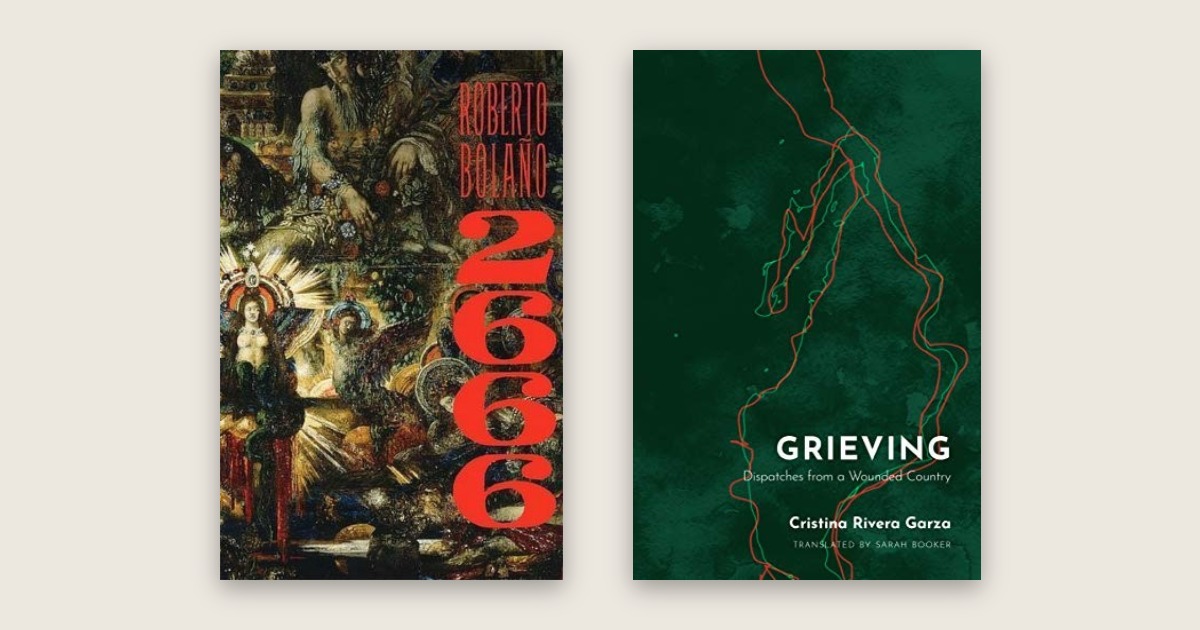
These two scenes framed Weeks 9 and 10 of my seminar, The Body Knows. On October 26, my students began reading “The Part About the Crimes” in 2666 (translated by Natasha Wimmer, Farrar, Straus and Giroux, 2008). On November 2, they turned to Grieving: Dispatches from a Wounded Country (translated by Sarah Booker, Feminist Press, 2020). One is a novel by a Chilean writer who died in Barcelona in 2003; the other, a book of chronicles by a Mexican writer who won the Pulitzer in 2024. Both texts return to the same territory, Ciudad Juárez and the border, and to the same scene: a woman’s body left in a public place. I asked the class to read these works in dialogue. The students observed that Bolaño teaches us to look, while Rivera Garza asks what actions we should take after looking.
The List
Bolaño depicts violence in the style of a police report. His prose provides street names, times, the color of a skirt, and little additional detail. It neither explains nor consoles. Subsequently, another body appears, and then another, continuing for nearly three hundred pages. When I asked my students to characterize this style, they described it as flat, cold, and almost bureaucratic. However, they also recognized that this coldness is intentional. Through repetition, Bolaño compels the reader to experience the normalization of the killings, mirroring the desensitization of the police and the media.
This repetition also exposes a pattern: the victims are young women, many of whom are maquiladora workers or migrants from the south. One victim remains unidentified. She was approximately thirty-five years old and pregnant; Bolaño imagines she was traveling to the United States to find the father of her child. Her body is discovered in a dump where the refuse from the slum accumulates “along with the waste of the maquiladoras” (358). Earlier, Bolaño describes the dusty plaza, the bus stop, the long walk along dirt roads to the factory gates, and the siren signaling the end of lunch. The landscape of labor and the landscape of death are indistinguishable.
To engage with these pages, we needed to situate Santa Teresa geographically and historically. We examined the border established after the Mexican-American War and the Gadsden Purchase, the twin cities of Ciudad Juárez and El Paso, and the maquiladora system initiated in 1965. Factories recruited women based on the myth of “nimble fingers,” rendering them both cheaper and supposedly more docile labor. We also explored Marcela Lagarde’s concept of feminicidio, which refers not only to the killing of women but also to the state that tolerates and leaves such crimes unpunished. Bolaño’s list, which “surely” omits some women (353), reflects the record-keeping of such a state.
The Horror
Rivera Garza begins her analysis where Bolaño’s witnesses fall silent. She contends that horror functions as a weapon. Bodies are mutilated and displayed to render witnesses incapable of speech or action. Drawing from Adriana Cavarero, she adopts the term “horrorism” and invokes the image of Medusa’s severed head. In the presence of a body destroyed beyond recognition, the witness opens their mouth, yet no words emerge.
This prompted one of the most insightful discussions of the semester: is horror distinct from fear? A student commented on Perusall that this distinction is crucial for understanding the crimes in Mexico. Fear activates the fight-or-flight response, allowing individuals to attempt escape. Horror, by contrast, leaves a person defenseless and nearly paralyzed; for crimes of this nature, the student argued, fear is an insufficient term. Fear pertains to personal survival, whereas horror relates to witnessing harm to another, immobilizing the observer. I then challenged the class with a provocation: Mónica Ojeda, whom we studied in October, describes the ear as the organ of fear. Might Rivera Garza be suggesting that the eye is the organ of horror?
Rivera Garza’s response to paralysis is dolerse: to grieve collectively and in public. She asserts, “It is impossible to grieve in the first-person singular.” She continues, “We always grieve for someone and with someone” (3). In a country where the state has instituted what she terms “visceraless relationships” with its citizens, “relationships without hearts or bones or innards” (8), grieving assumes a political dimension. It resists reducing the dead to mere statistics or collateral damage.
The Dialogue
When considered together, each book illuminates the other. Rivera Garza provides the vocabulary to articulate the effect of Bolaño’s prose: hundreds of pages of horror that compel us to look repeatedly, yet leave us unable to respond. Bolaño’s depiction of police, who arrive late and initially dismiss a dead girl as a joke, exemplifies the visceraless state before Rivera Garza named it. Conversely, Bolaño exposes the economic structures underlying Rivera Garza’s essays. The maquiladora, the siren, and the dump where factory waste merges with household trash illustrate that these killings occur within a system of production. Sayak Valencia’s Gore Capitalism, which we studied over these two weeks, helped the class recognize that, within this system, violence functions as a form of currency.
The students pushed these connections further. Several of them read the bribed police of 2666 as proof of the same broken social contract that Rivera Garza describes, where poor families search for the disappeared on their own and citizen search groups do the work of an absent government. Others read the displayed bodies as messages meant to keep whole communities silent, and remembered Néstor Perlongher’s “Corpses” and the Argentine dictatorship, which we studied in September. One student brought a 2014 study showing that students’ test scores dropped after a violent crime near their homes. The wound, the student suggested, reaches those who only watch. Others turned to Rivera Garza’s grief for her sister, Liliana, killed in Mexico City in 1990. Words cannot undo that suffering, they wrote, but they keep the stories alive.
In the phrase from Grieving, “I suffer with you” (2), the class identified the moment at which Bolaño’s silent witnesses might begin to speak.
The body registers violence before language can articulate it. Bolaño compels us to witness the bodies institutions seek to erase, refusing to let us look away. Rivera Garza insists that observation alone is insufficient without the labor of a publicly shared grief.


Leave a Reply